
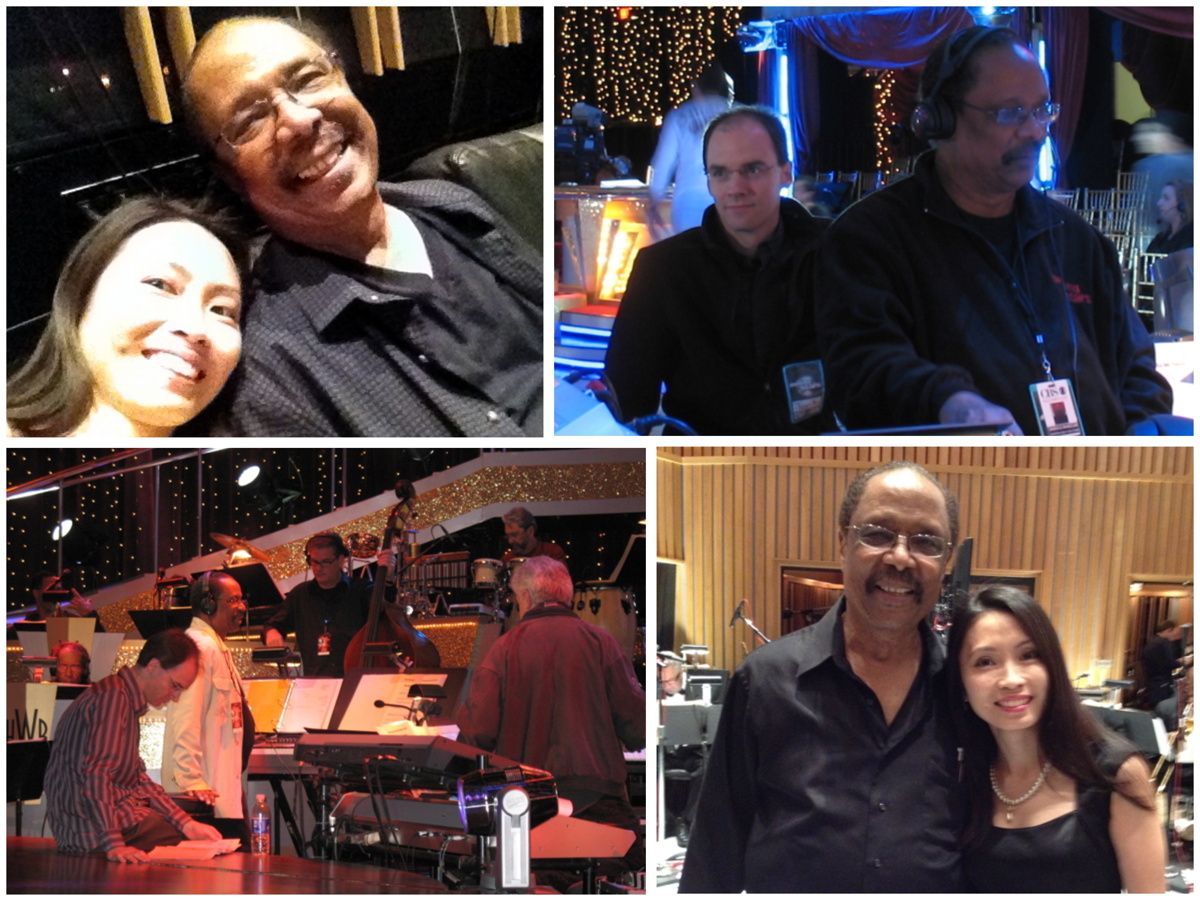
Four photos of Harold Wheeler with Danita Ng-Poss and Jason Poss. Top left: Close up of Danita & Harold sitting on a sofa in the recording studio. Their heads are close together and they are smiling while looking up at the camera. Top Right: Harold Wheeler playing a musical keyboard in the pit at Dancing With the Stars. Jason Poss is seated directly behind him. The studio behind is filled with lights and bunting. The audience chairs are empty, showing that this is during rehearsal. Lower Left: Jason Poss sits on the front of the Dancing With the Stars stage looking at some music. Behind him in the orchestra pit is Harold Wheeler, Trey Henry (bass), Tom Ranier (keyboards), Luis Conte (percussion), and Greg Porree (guitar). Bottom Right: Danita and Harold standing close together in the studio at Capitol Records during the Oscars. They are smiling directly at the camera, and are dressed in concert black.

Harold Wheeler, 1943-2026

Maestro and Friend

Harold Wheeler died June 24, 2026. It has been hard to know what to say about someone who was such a big part of our lives. Much has already been written about Harold and his illustrious career on Broadway, in Hollywood, and on numerous recordings. He was a music director for Burt Bacharach, the Academy Awards, and, most well-known, 17 seasons of Dancing With the Stars. His over 50 years as a Broadway arranger, orchestrator, and music director earned him a “Special Tony Award for Lifetime Achievement in the Theater”. He wrote and performed on numerous commercial jingles and hit records. Many people don’t realize he even was an arranger and producer on the famous disco album, “Star Wars and Other Galactic Funk”.

To us, he was Harold – a mentor, colleague, and friend of 20 years. He was a man who defined professionalism. He was a person who knew his stature, but never took himself too seriously. He always cared for those around him, and would defend anyone in his close-knit musical circle.

Our memories of Harold are of his hand-written scores, late night telephone chats during projects, lunches during shows, many trips to his home, and dinners with friends. Then there was the laughter; so much laughter on the bandstand, during breaks, at meetings, on the phone. Sometimes it was because this business is just so bizarre. Sometimes it was because we had to laugh because otherwise you might cry when things got Kafkaesque. Often it was simply because it was fun to remind ourselves that people are fun and silly, and the people around us are all that matters.

Without saying it, Harold always reminded us that being surrounded by lights, fame, celebrity, or money, didn’t mean much unless you could love those with whom you shared it. If you couldn’t find some joy, even if it came from a bit of witty sarcasm, then there wasn’t much reason for all of it.

Harold was not a perfect person, and he would be the first to admit it. His recognition of his own faults gave him the humility and compassion to accept the faults in others. He always demanded excellence from those with whom he worked, but he never forgot that we are all human. That humility also made him a superb professional who could smooth ruffled feathers and put the most demanding producers and celebrities at ease. When Harold was on the gig, they knew they were in good hands.

Harold cared about people, and he always worked while thinking of those around him. He didn’t think only about the people who had hired him. He also thought about the people working with him; the performers, copyists, engineers, directors and others who were required to bring the music to life. He would structure both his music and his workflow to enable those people to do their best work. When we were on a project with Harold Wheeler, we knew that everyone was expected to watch out and support each other, because Harold was watching out for us.

Harold himself could be exhausted by the demands of being a music director, but he was always re-energized by the payoff of being a part of the band. He loved “the hang” with his fellow musicians more than anything else; and that made him a musician other musicians loved. Harold also understood the challenges of being a minority person of color in a predominantly white society. He always cared for those who faced similar challenges, whomever they were.

On top of all that, Harold Wheeler was a stupendously skilled musician. Watching him write was daunting. His pencil moved with a speed we have never witnessed in anyone else. His hand was an extension of his mind, both on the page and at the piano. With perfect pitch, he could sit with a pair of headphones and a stack of score paper, and transcribe a recording directly to a new arrangement — no need to sketch it first. He could simply listen and then hear the new arrangement in his head. That was one of his secrets. He heard everything in his head before the pencil ever touched paper. He said the music went from his head to his heart to his hand.

Having his heart between his head and hand was a key element of both Harold’s writing and playing. It was never a technical exercise. He didn’t write a chart for instruments or voices. He wrote a chart for the people singing or playing those instruments. (You’d sometimes see their names next to their lines in the score.) The humanity made his music beloved because it moved people. Aside from knowing how to make an ensemble resonate and sing, he could use music to make people cry, laugh, and dance. Vocalists in particular adored him both as an arranger and accompanist because he knew how to support without ever getting in the way. He elevated the performance of anyone with whom he worked.

Harold, you are responsible for much of our careers, and you will be a part of everything we do. When faced with a musical or professional puzzle, we will still find ourselves asking, “What would Harold do?” The answer will probably be the best of all options. You gave us so much, and we hope we were able to give you much in return. Thank you for the music. Thank you for the knowledge. Thank you for the love. We miss you dearly.
Jo – The Little Women Musical Sheet Music

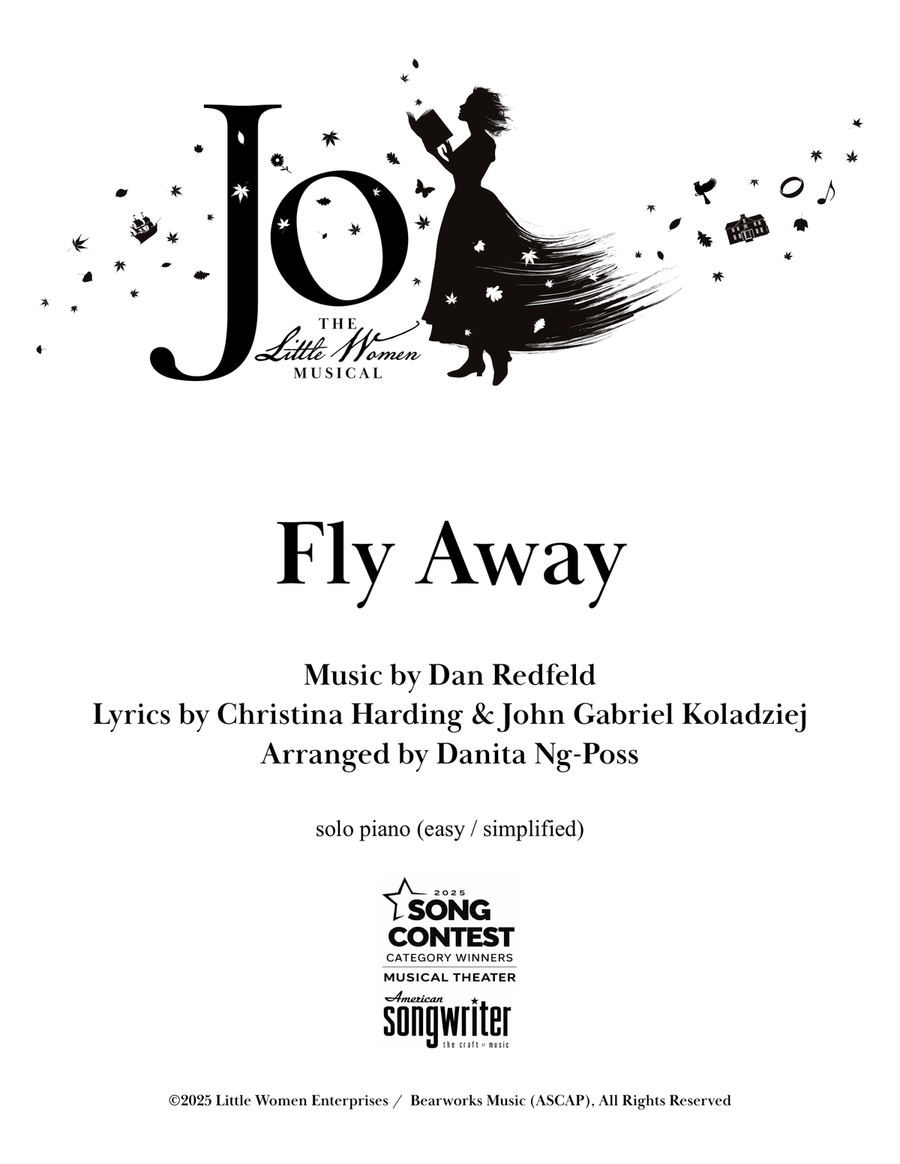
To answer the thousands of fans of Jo – The Little Women Musical, composer Dan Redfeld created piano/vocal arrangements of the show’s most popular songs. Symbols of Sound worked with Redfeld to edit and engrave sheet music of the arrangements. Redfeld also commissioned SoS’ Danita Ng-Poss to arrange an easy/simplified solo piano version of Jo’s most popular, award-winning song, “Fly Away”.

Sheet music for Jo – The Little Women Musical is now available for purchase at the following website links:

Sheet Music Plus

Sheet Music Direct

Kevin Bacon and Michael Bacon perform at the 7th Annual SCL Awards. Kevin is singing at a microphone with Michael who is also playing guitar. Behind them on stage is a guitarist, french hornist, percussionist, drummer, keyboardist, and bass player, all dressed in tuxedos. At the edges of the image a saxophonist, string, player, and other singers are visible.

7th Annual SCL Awards

The 7th Annual Society of Composers and Lyricists Awards were held February 6, 2026 in Los Angeles, hosted by The Bacon Brothers: Kevin Bacon and Michael Bacon. SoS once again provided music preparation and assembled an orchestra of LA’s finest musicians. The evening featured musical performances by Melissa Manchester, The Bacon Brothers, and a musical celebration of the 50th anniversary of the film Rocky conducted by composer Bill Conti.

In addition to the winners of competitive categories, the ceremony also honored the filmmaker-composer team of Ludwig Göransson and Ryan Coogler with the Spirit of Collaboration Award, which featured live performances of music from Black Panther, Creed, and Sinners.

7th Annual SCL Awards Orchestra

Bob Sheppard – tenor sax, clarinet
Sal Lozano – alto sax, flute, piccolo
Jacob Scesney – tenor sax, flute, clarinet
Ian Dahlberg – bari sax, oboe, clarinet

Laura Brenes – french horn

Jamie Hovorka – trumpet, flugelhorn
Tony Bonsera – trumpet, flugelhorn
Chris Tedesco – trumpet, B-flat french horn

Andy Martin – trombone
Craig Gosnell – trombone, bass trombone

Rich Ruttenberg – keyboards

George Doering – guitar

David Hughes – electric & acoustic bass

Gary Novak – drumset

MB Gordy – percussion

Alison Bjorkedal – harp

Alyssa Park – violin (concertmaster)
Marisa Kuney – violin
Songa Lee – violin
Heather Powell – violin
Julie Rogers – violin
Irina Voloshina – violin

Luke Maurer – viola
Neel Hammond – viola

Evgeny Tonkha – cello
Cameron Stone – cello

ASMAC presents Jo: The Little Women Musical, Creating a Studio Cast Album

Saturday, September 20, 2025 - 12pm PDT (19:00 UTC)

Join Symbols of Sound’s Danita Ng-Poss and Jason Poss and the creative team of Jo: The Little Women Musical online for a free, in-depth look at creating a studio cast album. Presented by the American Society of Music Arrangers and Composers (ASMAC), the discussion will be hosted by Nan Schwartz and Conrad Pope.

The Jo creative team, and maybe a cast member or two, will share their thoughts about the show, the music, process, and the studio cast album recorded at Abbey Road Studios.

Guests will include Dan Redfeld (composer); Christina Harding, & John Koladziej (lyricists); JoAnn M. Hunter (director); nigel wright (co-producer); Nick Pugh (music engineer); music prep team of Danita Ng-Poss, Jason Poss, and Chris Siddall; plus cast members Laura Benanti and Christine Allado.

Click here to register for the online event, Saturday, September 20, 2025 at 7pm PDT (19:00 UTC).

Jo – The Little Women Musical

We are thrilled with the release of the beautiful London recording of Jo – The Little Women Musical. For three years, SoS has been working with composer Dan Redfeld on the new musical based on Louisa May Alcott’s classic novel Little Women. SoS has provided music preparation for multiple orchestral recording sessions in Los Angeles and London. Jason Poss was in the engineer’s booth as score reader and providing feedback during the initial orchestral and vocal recordings in Los Angeles.

With the song “Fly Away” already an internet sensation, the full album release is over 2 hours of music by Dan Redfeld, book and lyrics by Christina Harding and John Gabriel Koladziej. Jo features a mix of Broadway, West End, and international stars and a 29-piece orchestra recorded at Abbey Road Studios. The album is produced by five-time Grammy nominee and three-time Emmy winner Nigel Wright and Dan Redfeld.

The cast includes Tony Award winner and five-time Tony Award nominee Laura Benanti as Marmee March, two-time Tony Award winner Christine Ebersole as Aunt March, Olivier nominated West End and Broadway star Julian Ovenden as Father, Grammy Award nominated Christine Allado as Jo March, two-time Tony Award nominee Bob Gunton as Grandfather, West End star Kelly Mathieson as Meg March, TV star Sophie Pollono as Amy March, Eleanor Grant as Beth March, Rob Houchen as Theodore “Laurie” Laurence, Chris Mann as Professor Bhaer, Liam Tamne as John Brooke, Tobias Turley as Fred Vaughn, and Miyuki Miyagi as Sallie Gardiner.

For more information along with videos, audio, and links to purchase sheet music, to visit the Jo – The Little Women Musical website.